
Most couch damage doesn’t come from the original spill or stain—it comes from the panicked cleaning attempt that follows. A small wine stain or pet accident triggers an immediate response, and within minutes, people are scrubbing with whatever’s under the sink, using hot water, or applying multiple products in quick succession. The irony is that couches are built to withstand years of daily use, but they’re surprisingly vulnerable to aggressive or misguided cleaning. Upholstery fabrics, fillings, and frames can be permanently altered by methods that seem harmless in the moment, and the damage often doesn’t become fully visible until hours later when it’s too late to reverse. Slowing down and doing less frequently prevents more problems than any cleaning method solves.
Understand the Material First
The single factor that determines whether cleaning will help or cause permanent damage is the type of upholstery fabric, and most people have no reliable way to identify what they’re working with. A couch might be microfiber, polyester, cotton, linen, wool, velvet, or a blend, and each of these responds differently to water, solvents, and mechanical friction. Some fabrics tolerate moisture well, while others water-spot immediately or shrink when wet. Certain weaves can handle gentle scrubbing, but others pill, fray, or develop a permanently flattened texture from the same treatment. The cleaning code tag—usually tucked under cushions or on the bottom of the frame—provides basic guidance, but these tags fade, get removed, or use vague symbols that aren’t as clear as they seem.
Different fabrics react very differently to moisture, friction, and cleaning agents, which is why some materials are far easier to damage than others.
Even when a tag exists, the codes only offer rough categories. “W” means water-based cleaning is generally safe, “S” means solvent-only, “SW” means either might work, and “X” means professional cleaning only. But these designations don’t account for how much water is safe, what concentration of solvent to use, or how the fabric will respond to specific stains. A couch marked “W” can still water-spot, shrink, or develop rings if too much moisture is used or if it doesn’t dry evenly. Before applying anything to the main stain, it’s worth pausing to question whether you actually understand what will happen, because guessing wrong with upholstery usually creates damage that’s more expensive to fix than the original problem. These upholstery cleaning codes are widely used across the furniture industry, but they’re often misunderstood by homeowners.
Safe Methods That Often Work
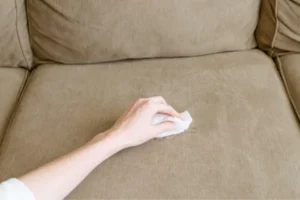
For fresh spills on water-safe fabrics, blotting immediately with a clean, dry cloth can absorb most of the liquid before it sets into the fibers. The technique matters more than people expect—pressing down gently and lifting straight up works, while wiping or rubbing spreads the stain outward and pushes it deeper into the cushion foam. Each blot should use a fresh section of cloth, since reusing a saturated area just transfers the stain back onto the fabric. Once the visible liquid is gone, the temptation is to keep going with water or cleaner, but sometimes stopping at this point prevents the larger problems that come from over-wetting.
If blotting alone doesn’t remove the stain, a very small amount of cool water applied with a barely-damp cloth can help lift residue from certain fabrics. The key is using far less water than feels adequate, because upholstery cushions don’t dry quickly or evenly, and excess moisture can lead to mildew, permanent water rings, or separation between fabric and backing. Dabbing lightly and checking progress after each pass gives you a chance to stop before the fabric becomes saturated. If the stain isn’t noticeably lighter after a few careful attempts, continuing with more water probably won’t help and increases the risk of creating new problems that are harder to address than the original mark.
Mild dish soap diluted heavily in water works for some oil-based stains on durable synthetic fabrics, but it fails unpredictably on natural fibers and can leave a sticky residue that attracts dirt if not rinsed thoroughly. Rinsing upholstery properly is nearly impossible without professional equipment, which means soap often creates a cleaning cycle where the area looks good initially but becomes dingy within days. Using the absolute minimum amount and stopping while the fabric is still mostly dry gives better long-term results than soaking the area and trying to extract all the soap later.
Solvent-based cleaners designed for “S” coded fabrics can work when water would cause damage, but they also carry significant risk. These products often contain harsh chemicals that can discolor certain dyes, dissolve fabric finishes, or leave strong odors that persist for weeks. Testing in a hidden area isn’t just a suggestion—it’s the only way to know whether the cleaner will do what you expect. Even then, the test spot might react differently than the stain area due to variations in dye saturation or existing wear patterns. If you’re uncertain about whether to proceed after testing, that uncertainty is usually a sign that the risk is too high.
Common Mistakes to Avoid
Scrubbing feels productive, but it’s one of the fastest ways to permanently alter upholstery texture. The friction breaks down fabric fibers, creates a matted or fuzzy appearance, and often spreads the stain into surrounding areas. People scrub because they’re frustrated that gentler methods aren’t working fast enough, but that frustration is usually a signal that the stain has already bonded in ways that surface cleaning won’t fix. The energy spent scrubbing would be better used stepping back to reconsider whether continuing is actually helping.
Using too much liquid is the most common source of permanent damage, even when the liquid itself is appropriate for the fabric. Upholstery foam and batting hold moisture for days, creating ideal conditions for mildew, odors, and structural breakdown. The fabric might look clean on the surface, but underneath, the cushion is slowly degrading in ways that won’t become obvious until much later. Water rings form when the outer edges of a wet area dry faster than the center, pulling dissolved dirt and dyes outward into a visible line that’s nearly impossible to remove. Once a water ring sets, even professional cleaning often can’t fully eliminate it.
In many cases, repeated or aggressive cleaning slowly changes the fabric’s texture and appearance long before any visible damage is obvious.
Layering multiple products during the same cleaning session creates chemical interactions that nobody can predict. One cleaner might react with residue from another, causing discoloration, sticky buildup, or fabric stiffening that wasn’t there before. The impulse to try something different when the first method doesn’t work completely is understandable, but it’s usually wiser to stop with a partially improved stain than to risk making the area impossible to salvage later.
Heat from hair dryers, irons, or steam cleaners sets many types of stains permanently by bonding them to fabric fibers at a molecular level. Heat also shrinks certain fabrics, distorts foam padding, and can melt synthetic materials. The damage isn’t always immediate, which is why heat seems safe at first, but the stain becomes darker and more stubborn as it cools, and by then, the change is irreversible.
When to Stop and Call a Professional
If the stain spreads during cleaning instead of lifting, continuing will only expand the damaged area. Professional upholstery cleaners have extraction equipment that removes moisture and cleaning agents from deep within cushions, preventing the buildup and water damage that home methods can’t avoid. Stopping early means they’re working with a contained problem rather than trying to reverse widespread discoloration, texture changes, or chemical residue from multiple failed attempts. Professional upholstery cleaners use extraction equipment that removes moisture and cleaning agents from deep inside cushions, something home methods simply can’t replicate.
Visible changes in fabric texture, color fading, or areas that won’t dry within a few hours are clear signs that the material has been compromised. At that point, professional restoration might still be possible, but only if you stop immediately and don’t try additional home remedies. Expensive, antique, or light-colored couches probably warrant professional cleaning from the start, since the cost of replacement or reupholstering far exceeds the cost of proper cleaning.
If you’re unsure about the fabric type, uncomfortable with the methods, or already noticing that the stain looks worse after your attempts, those are all legitimate reasons to stop. Calling someone who cleans upholstery daily isn’t an admission of failure—it’s recognizing that preventing irreversible damage matters more than solving the problem yourself right now.
Final Thoughts
There’s no universal cleaning method that works safely across all upholstery types, and what succeeds on one couch can permanently damage another that looks nearly identical. The approaches that carry the least risk are also the ones that feel inadequate when you’re standing there wanting immediate results, which makes it difficult to trust restraint over action. The reality is that most permanent couch damage happens because someone kept going past the point where stopping would have preserved the fabric, and knowing when to pause matters more than knowing which product to try next. Not every stain can be removed at home without risk, and accepting that limitation early is often what separates a small imperfection from furniture that needs replacing.