
After cleaning a couch, odors are often expected to fade from the areas that were treated. When a smell later appears somewhere that was never cleaned at all, it can feel confusing or even alarming. The assumption is usually that odor should stay tied to the original problem area. In reality, couches behave as connected systems, and smells do not always respect surface boundaries. This same system behavior explains why couches often smell worse days after they initially seem dry. Uneven pressure from sitting in the same spot can influence where moisture settles over time.
Understanding this pattern requires stepping away from the idea that cleaning isolates problems. Slowing down and looking at how internal materials interact can make these odor shifts feel less mysterious.
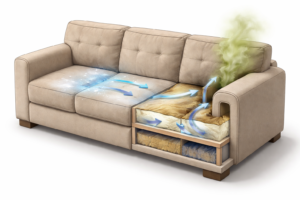
A Couch Is Not a Set of Independent Zones
A couch may look like separate cushions and sections, but internally it functions as a single structure. Foam, batting, and internal fabrics often connect across seams and frames. Air, moisture, and absorbed compounds can move through these shared layers over time.
When one area is cleaned, moisture introduced there does not always stay confined. It can migrate through internal materials and settle in adjacent or lower areas that were never directly treated. Pausing before assuming a new spill or new contamination can help prevent unnecessary repeat cleaning.
It is often more accurate to think of odor as relocating rather than appearing out of nowhere.
How Moisture Movement Shifts Odors
Odors inside a couch are closely tied to moisture. Even small amounts of moisture can reactivate smells that were previously dormant. After cleaning, moisture begins to redistribute internally rather than evaporating evenly.
As moisture moves, it can carry odor-causing compounds with it or activate materials that were previously dry. This is why a smell may become noticeable in an armrest, back cushion, or corner that was never cleaned. The odor did not originate there, but conditions there changed.
Allowing time without additional disturbance can help reveal whether moisture is still migrating or beginning to stabilize.
Why Untouched Areas Can Smell Stronger
Areas that were never cleaned may actually be more vulnerable to odor release. These sections often have less airflow and were not disturbed during cleaning, so they may retain absorbed residues more easily.
When moisture reaches these quieter zones, odors can become more noticeable because nothing is actively dispersing them. This can feel backward, especially when cleaned areas smell fine. Slowing down before reacting can prevent chasing the smell from one area to another.
The location of the odor often reflects where conditions became favorable, not where the problem began.
Internal Air Pathways and Pressure Changes
Couches contain small air pathways within their padding and frame. Sitting, standing up, and even temperature changes can push air through these pathways. As air moves, it can carry odor molecules toward openings or seams.
After cleaning, changes in internal pressure can redirect airflow toward areas that were not previously noticeable. A smell that emerges days later may simply be following a new internal route. This does not mean something new went wrong; it often means internal balance is still shifting.
Reducing use for a period can limit pressure changes and allow airflow patterns to settle.
The Role of Gravity and Position
Gravity quietly influences where moisture and odors end up. Moisture tends to move downward over time, especially inside dense materials. Odors can follow that movement.
This is why smells often show up near the base of the couch, along the back, or in lower cushions that were never cleaned. These areas become collection points as internal conditions adjust. Recognizing gravity’s role can reduce the urge to repeatedly clean surface areas that are not the true source.
Sometimes the most effective response is simply to wait and observe how conditions continue to change.
Common Assumptions That Lead to Confusion
A common assumption is that cleaning one area “fixes” the problem entirely. In practice, cleaning often starts a new internal process rather than ending it. Expecting immediate final results can make normal transitions feel like failures.
Another assumption is that odors should fade in a straight line over time. Odor intensity often fluctuates as moisture redistributes. Reacting to every change can interrupt stabilization rather than help it along.
Choosing restraint over repeated action can feel uncomfortable, but it often leads to clearer outcomes.
Why Recleaning Untouched Areas Often Backfires
When odors appear in an untreated area, the instinct is often to clean that spot next. This can introduce more moisture and restart internal movement, pushing odors yet again.
Repeated spot cleaning can turn a contained situation into a wider one. It can also make it harder to tell whether conditions are improving or simply shifting. Pausing before recleaning allows internal processes to complete rather than resetting them.
Doing less for a period can sometimes be more informative than doing more.
When Odors Indicate a Broader Internal Issue
Not all odor movement is temporary. If smells continue to spread, intensify, or change character over time, it may indicate that moisture remains active across multiple internal areas. This is often the point where ignoring mild couch odors can lead to broader problems.
In these situations, continued normal use often adds variability rather than clarity. Reducing interaction and allowing longer rest periods can help determine whether the system is stabilizing or still changing.
It is reasonable to acknowledge limits early instead of forcing a quick resolution.
Seeing Odor as a System Signal, Not a Location Problem
Odor location is often the signal, not the source. A couch communicates internal conditions through smells because they are one of the few things that escape to the surface.
When odors appear away from cleaned areas, it is usually an indication of internal redistribution rather than neglect or new contamination. Viewing the couch as a system helps replace frustration with understanding.
Sometimes the most controlled response is patience rather than precision.
FAQ
Why does the smell come from a place I never cleaned?
Internal moisture and air movement can activate odors in areas that were previously dry or inactive. The smell often reflects changing conditions, not a new problem.
Does this mean cleaning was done incorrectly?
Not necessarily. Odor movement is a common post-cleaning effect when internal layers are still adjusting.
Should the newly smelly area be cleaned next?
Not immediately. Recleaning can introduce more moisture and restart internal movement. Waiting can provide clearer signals.
How long should you wait before acting?
There is no fixed timeline. Watching whether odors stabilize, fade, or continue to spread offers more guidance than reacting right away.
Couch odors appearing in unexpected places can feel unsettling, but they are often part of a larger internal adjustment. When smells shift instead of disappearing, slowing down and observing the system as a whole usually leads to better decisions than chasing individual spots.