
After a couch has been cleaned or exposed to moisture, uneven drying is one of the most common and confusing outcomes. One area may feel completely dry while another remains cool, heavy, or slightly damp. This can happen even when the cleaning was careful and conditions seemed reasonable. Understanding why this unevenness occurs requires looking beyond the couch itself and slowing down to consider how real homes actually behave.
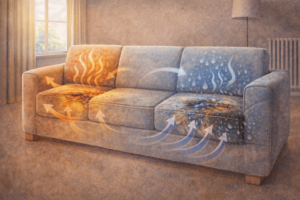
Why Uneven Drying Feels Unexpected
Most people expect drying to happen evenly. If the couch was cleaned all at once, it feels logical that it should dry the same way. When this does not happen, it can seem like something went wrong during cleaning. This assumption is understandable, but it often misses the bigger picture.
Drying does not occur in isolation. It responds to many small, overlapping factors in the home. Taking a step back from the cleaning process can make uneven results feel less mysterious.
Homes Do Not Have Uniform Conditions
Rooms rarely have consistent temperature, airflow, or humidity from one side to the other. Air may move freely in one area and remain still in another. Walls, windows, furniture placement, and even ceiling height can create micro-zones with different conditions.
A couch that spans multiple zones will dry according to each one. This means one cushion can release moisture quickly while another holds onto it longer. Accepting that rooms are uneven environments can reduce the urge to search for a single mistake.
Airflow Reaches Some Areas Better Than Others
Airflow plays a major role in drying, but it does not reach all parts of a couch equally. Airflow patterns inside real homes rarely distribute moisture removal evenly. Air may pass over armrests and seat tops while barely touching the back or lower cushions. Areas pressed against walls or tucked into corners often receive less movement.
This uneven exposure means moisture escapes more easily from some sections than others. Pausing before assuming the couch is “mostly dry” can prevent overlooking these sheltered areas.
Cushion Structure Slows Drying in Different Ways
Not all cushions are built the same. Moisture inside couch cushions can remain longer depending on internal structure. Some are denser, thicker, or layered differently than others. Even cushions that look identical on the outside may respond differently internally. These differences affect how moisture spreads and how long it takes to leave.
Because cushion structure is hidden, uneven drying can feel random. Assuming that internal differences exist—even when they are not visible—can help set more realistic expectations.
Gravity and Pressure Influence Moisture Movement
Moisture does not stay where it started. Gravity encourages it to move downward, while pressure from the couch’s own weight or earlier use can push it sideways. As a result, moisture may collect in lower or compressed areas.
These shifts happen quietly and gradually. Allowing time for moisture to settle and move naturally is often safer than trying to force uniform drying.
Temperature Differences Inside the Same Room
Temperature can vary within a single room. Heating cycles can create repeated temperature shifts that affect moisture behavior. Areas near windows, exterior walls, or heating sources may warm or cool faster than others. These differences affect evaporation rates across the couch.
Surface areas exposed to warmer air may dry quickly, while cooler zones lag behind. Recognizing that temperature is not evenly distributed can explain why drying feels inconsistent.
Why Adjusting One Thing Rarely Fixes Everything
When uneven drying is noticed, it is tempting to adjust one factor—more air, more heat, or repositioning cushions. While this can help some areas, it may leave others unchanged. In some cases, repeated adjustments create new unevenness.
Doing less and allowing conditions to stabilize can sometimes be more effective than constant intervention. Uneven drying often resolves slowly rather than through quick fixes.
Time Reveals the Pattern
Uneven drying often becomes clearer over time. Areas that seemed fine may develop odors or feel different days later, while others remain unchanged. This delayed feedback can be frustrating, but it reflects how moisture behaves gradually.
Waiting before drawing conclusions can help distinguish between temporary unevenness and a real problem. Patience allows patterns to emerge without adding new variables.
Accepting Unevenness as Normal
In real homes, perfectly even drying is rare. Uneven results do not automatically mean damage or failure. They usually reflect the natural interaction between furniture and environment.
Accepting this reality can reduce unnecessary worry and repeated action. Allowing the couch to dry on its own timeline is often the most protective choice.
FAQ
Does uneven drying mean the couch is damaged?
Not necessarily. Uneven drying is common and often resolves with time.
Why does one cushion dry much slower than the others?
Differences in airflow, temperature, and internal structure can all contribute.
Should cushions be moved to even things out?
Sometimes, but frequent repositioning can also interrupt natural drying. Waiting is often safer.
How long should uneven drying be tolerated?
There is no fixed timeline. When in doubt, allowing more time is usually the lower-risk option.