Solving an appliance issue often brings relief. A malfunction is identified, a fix is applied, and the appliance appears to return to normal operation. It feels reasonable to expect that any related damage will stop at the same time. It is often worth slowing down here, because in many cases damage continues even after a specific appliance issue has been addressed.
This article explains why targeted solutions do not always halt ongoing damage, and how underlying conditions can persist beyond a single successful fix.
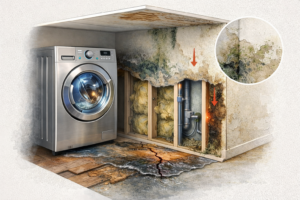
Why a Single Fix Feels Like a Full Resolution
Appliance problems are usually framed as cause-and-effect. One issue produces one symptom, and fixing the issue should remove the symptom. This logic works when the problem is isolated and recent. This assumption explains why isolated appliance fixes fail when damage has already spread beyond the original issue.
However, this framing can linger even after conditions have changed. Pausing to question whether the issue was truly singular can help explain why damage may continue despite a fix that appears correct.
Resolution feels complete when the symptom disappears.
How Damage Can Outlast the Original Problem
Damage often begins before a problem is noticed. Moisture, heat, vibration, or stress may have been affecting surrounding materials for some time before the appliance issue became obvious.
When the appliance is fixed, these materials do not immediately recover. This delay reflects why appliance problems often trigger secondary home damage that continues after repairs. Slowing down to recognize that damage has its own timeline helps explain why effects continue after the cause is removed.
Correction does not rewind history.
Why Repairs Don’t Always Address Environmental Effects
Most appliance repairs focus on restoring function. They do not necessarily address changes that occurred in the surrounding environment while the appliance was malfunctioning.
Moisture trapped in materials, stress redistributed through structures, or altered airflow patterns may remain. These lingering effects are common when appliance damage becomes a structural concern rather than a simple repair task. Pausing to separate appliance function from environmental condition can prevent false confidence that everything has been resolved.
Function and impact are not the same thing.
Check the Surrounding Area After an Appliance Repair
Restored appliance operation does not confirm that nearby materials are dry. After the repair, inspect accessible cabinet bases, the floor edge, wall trim, and the space beneath or beside the appliance for staining, swelling, or dampness. Compare dated photos rather than relying on memory. Do not reach behind powered equipment or touch wet electrical connections.
If the same area becomes wet again, record when it happens and contact the repairer. If water reached concealed flooring or a wall, a qualified water-damage specialist may need to assess it even when the appliance now runs normally. See signs of appliance-related wall moisture.
Why Damage Often Appears to “Restart”
When damage becomes visible after a fix, it can feel like something new has gone wrong. In reality, the damage may have been ongoing all along, simply crossing a visible threshold later.
Pausing to reframe “new” damage as delayed visibility can reduce confusion and misplaced blame on the repair itself.
What looks new may be old.
How Partial Fixes Change Damage Patterns
Some fixes resolve one aspect of a problem while leaving others untouched. This can change how damage develops without stopping it.
For example, a repair might reduce active moisture release but leave damp materials behind, allowing slower forms of deterioration to continue. Slowing down to consider what the fix did not change can clarify why damage persists.
Partial solutions reshape, not erase, conditions.
Why Repeated Fixes Can Create False Assurance
Each successful fix reinforces the belief that the issue is under control. Over time, this confidence can delay recognition that damage has moved beyond the appliance.
Pausing to reassess after multiple fixes—rather than assuming progress—is often necessary to understand whether damage is still evolving.
Confidence can lag behind reality.
How Time Delays Mask Ongoing Damage
Ongoing damage often unfolds slowly. The gap between cause and visible effect allows problems to persist unnoticed.
When fixes are applied intermittently, this delay can make it hard to connect ongoing damage to earlier appliance issues. Slowing down to look at long-term patterns instead of recent events can restore context.
Time blurs cause and effect.
Why Ongoing Damage Is Often Misattributed
When damage continues after a fix, attention may shift to new explanations: aging materials, unrelated defects, or external factors. While these may contribute, they can also distract from the original pathway.
Pausing to keep earlier appliance issues in view can help avoid misattributing damage that is actually part of a longer process.
New explanations do not erase old influences.
What to Do if Damage Continues After a Repair
Do not repeatedly run a leaking or electrically unsafe appliance just to confirm the symptom. Stop use, isolate the water supply if it is safe to do so, and contact the original repairer with the date of service, what was repaired, and the new observations. Ask whether the original fault has returned or whether a separate plumbing, drainage, or installation issue is possible.
If materials remain damp, begin appropriate water cleanup and obtain professional assessment where needed; simply waiting to see whether damage spreads is not a safe substitute for addressing active moisture. Keep repair invoices, photos, and a brief timeline for follow-up or an insurance claim.
Separate the Repaired Fault From Residual Water Damage
There are two different questions after a repair: is the appliance operating safely, and have the affected materials recovered? An appliance technician can test the repaired component, while a plumber or water-damage professional may be needed to trace a leak or evaluate wet flooring and wall cavities.
Ask for a clear description of what the repair covered and what it did not. If a damp smell, discoloration, or material swelling persists, do not assume that normal appliance operation proves the area is dry. Follow the upholstery, flooring, or building-material guidance appropriate to the affected surface.
FAQ
Why does damage continue after an appliance is fixed?
Because damage often began earlier and has its own momentum. Pausing to consider timelines helps explain the gap.
Does this mean the repair was wrong?
Not necessarily. The repair may have addressed the appliance correctly without reversing environmental effects.
Why does damage seem to reappear later?
Because it may never have stopped. Visibility often lags behind progression.
What’s the safest response when unsure?
Restraint and observation. Doing less while reassessing whether damage is still active can prevent misinterpretation.