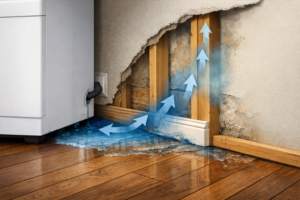
Moisture problems from appliances are often associated with floors. Water is expected to spread outward along the ground, not upward. When wall damage appears, it can feel unexpected or unrelated. It is often worth slowing down at this point, because moisture from appliances can travel vertically long before obvious signs appear.
Understanding how moisture moves from appliances into nearby walls helps explain why damage sometimes shows up far from the original source. What looks like a wall issue may have started much lower and much earlier.
Why Wall Damage Feels Unrelated at First
Walls feel separate from appliances. They are vertical, distant from hoses and drains, and usually dry to the touch. When discoloration or softness appears, it is often blamed on humidity or external leaks.
This separation makes it easy to miss the connection. Pausing to consider what lies behind the wall surface can reveal pathways that are not visible. Moisture does not respect visual boundaries.
What feels unrelated may be connected beneath the surface.
How Moisture Moves Upward From the Floor
When water escapes from an appliance, it often spreads across the floor first. This is the same process described when appliance leaks damage floors before you notice, long before moisture begins affecting walls. From there, it can be absorbed into baseboards, drywall edges, or framing materials. These materials act like wicks, slowly drawing moisture upward.
This process is gradual and uneven. Walls may absorb moisture at different rates depending on materials and construction. Slowing down to understand this movement can explain why wall damage appears delayed.
Moisture often rises quietly before it announces itself.
Why Early Wall Signs Are Easy to Miss
Initial wall damage from moisture is subtle. Paint may bubble slightly, textures may change, or corners may feel different to the touch. These changes are easy to dismiss as cosmetic or seasonal.
Because they develop slowly, they rarely trigger immediate concern. Pausing to notice small, repeated changes can be more revealing than waiting for obvious damage.
Early signs are often ambiguous by nature.
How Repeated Exposure Changes Wall Materials
Just like floors, walls are affected more by repetition than by single events. A small amount of moisture absorbed repeatedly can weaken materials over time.
Drywall edges may soften, fasteners may lose grip, and framing may hold residual dampness. Slowing down after recurring moisture exposure can help recognize accumulation before it becomes structural.
Walls remember moisture longer than they show it.
Why Damage Often Appears Above the Actual Source
Wall damage is frequently noticed higher than where moisture entered. This can create confusion about the cause. In reality, moisture may have traveled upward inside the wall cavity before spreading outward.
By the time surface damage is visible, the original source may no longer be obvious. Pausing before assuming a new leak can help trace the issue back to its origin.
Visible damage is not always closest to the cause.
How Appliance Placement Influences Wall Impact
Appliances placed near walls create narrow spaces where moisture can linger. Limited airflow slows drying and encourages absorption into nearby surfaces.
Over time, these conditions make walls more vulnerable, even to small leaks. Slowing down to consider appliance placement can explain why certain walls are affected while others remain unchanged.
Proximity increases exposure, even without constant leaks.
Why Wall Damage Can Progress Faster Than Expected
Once wall materials begin absorbing moisture, deterioration can accelerate. Materials lose strength and resist drying, making each new exposure more impactful.
This acceleration can make damage seem sudden. This shift reflects why appliance damage rarely stays at the same severity level once moisture has weakened materials. Pausing to recognize that walls have already been weakened can help make sense of rapid changes.
Speed increases after thresholds are crossed.
Why Repainting a Damp Wall Can Make the Problem Harder to Find
Peeling paint, a brown tide mark, softened baseboard, or bubbling drywall near a dishwasher or washing machine should prompt a leak check before cosmetic repair. Paint or caulk applied over damp material does not stop a leaking supply line or drain. It can conceal a continuing problem while the affected material stays wet.
Compare the wall with the appliance running and at rest, without touching wet electrical equipment or opening the wall. Photograph the location and height of the mark, check whether the baseboard or floor edge is also affected, and tell a plumber or restoration professional whether the mark grows after a wash cycle. If the wall is soft, moldy, or repeatedly damp, ask for an assessment of concealed moisture before repainting.
The EPA recommends fixing the water source and drying the material before painting or caulking affected surfaces.
A Safe Check for Appliance-Related Wall Moisture
- Locate the pattern: record whether staining is behind the machine, beside a shared wall, at the baseboard, or above floor level. A high mark alone does not establish where the water started.
- Compare likely sources: appliance supply hoses, drain connections, plumbing inside the wall, and condensation can create different patterns. Do not assume the appliance is responsible solely because it is nearby.
- Watch for urgent hazards: if moisture reaches an outlet or switch, avoid touching it and have a qualified electrician make the area safe. If a supply or drain is actively leaking, contact a plumber.
- Escalate hidden damage: persistent dampness, swollen trim, soft drywall, or musty odor can justify a moisture assessment. Do not cut into a wall without checking for wiring and plumbing.
For the broader path that water can take beyond the appliance, see how appliance water damage can reach adjacent areas.
FAQ
Why is the wall stained above the floor?
Porous materials can draw water upward, but a stain’s height does not prove the source. A leak inside the wall or condensation may also be involved.
Can I paint over a dried water mark?
First confirm that the leak is fixed and the wall material is dry. Repeated staining, softened drywall, or odor calls for further investigation before repainting.
Who should inspect the problem?
A plumber can investigate water-supply and drain leaks; a qualified restoration professional can assess damp building materials. Involve an electrician if water affects wiring or outlets.
Does a dry surface rule out hidden moisture?
No. Moisture may remain behind paint or trim. Where damage is persistent or concealed, a professional moisture assessment is more reliable than touch alone.