
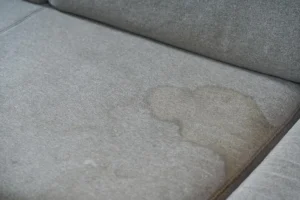
Water stains don’t always come from spills. Often, they appear after careful cleaning that used minimal moisture and light pressure. Rings, dark patches, or texture changes can show up even when the process felt cautious. This happens because water doesn’t behave predictably once it enters layered fabric and padding. The marks left behind reflect how moisture moved and dried—not how careful the cleaning was.
Why This Stain Is Difficult
Water stains are confusing because they seem to contradict good intentions. Gentle cleaning doesn’t ensure even drying, and in some cases, light moisture is more likely to settle unpredictably. Water moves according to fabric structure, padding density, and internal layers—not according to how carefully it’s applied. As moisture spreads and dries, it can pull dissolved materials toward the edges of the damp area, leaving visible rings or shadows. These marks aren’t dirt returning; they’re evidence of moisture movement. Moisture inside a couch doesn’t stay where it enters and can move through internal layers long after cleaning.
Understanding the Fabric First
Some fabrics are prone to water staining regardless of technique. Tight weaves or treated surfaces may resist absorption, causing uneven drying. Looser fabrics absorb water quickly but release it at different rates depending on what’s underneath. Microfiber and velvet are especially sensitive because moisture can disrupt fiber alignment and texture. Older fabrics may also absorb and release moisture unevenly due to wear or degradation, increasing the risk of visible marks.
How Moisture Movement Creates Visible Rings
Once water enters fabric, it spreads outward and downward rather than staying where it was applied. As it moves, it carries dissolved substances—residue, oils, or even fabric dyes. When the moisture evaporates, those substances are deposited at the edges of the wet zone, creating a ring or halo. Even clean water can redistribute materials already present in the fabric. By the time the ring appears, the movement has already happened.
Water can spread through porous materials by absorption, moving beyond the area where it was first applied.
Why Uneven Drying Leads to New Marks
Fabric rarely dries evenly. Areas with more airflow dry faster, while sections with thicker padding or less ventilation stay damp longer. These differences create visible boundaries where moisture left one area before another. Air drying can unintentionally create water rings when different areas of a couch dry at different speeds. Textured fabrics can also change appearance as fibers flatten or shift during drying. In some cases, fabric darkens while wet and never fully returns to its original look if drying is slow or uneven.
Why Gentle Cleaning Still Leads to Stains
Using less water doesn’t stop moisture from migrating. In fact, light cleaning can leave residue concentrated near the surface, where it’s more likely to be redistributed as the fabric dries. Gentle moisture may also fail to wet the fabric evenly, creating patches that dry at different speeds. If a fabric has a coating, water can become trapped between layers and dry irregularly, increasing the chance of marks.
Why Re-Cleaning Often Makes Water Stains Worse
When a water stain appears, the instinct is to clean again. This usually expands the affected area and adds moisture to fabric that may not have dried fully. Each attempt increases the chance of uneven drying, residue buildup, or texture change. If the stain formed because of drying behavior rather than surface dirt, repeating the process won’t solve it and often makes it more visible. Pausing and allowing complete drying before taking further action can prevent compounding the problem.
Fabric Types That Require Extra Caution
Microfiber, velvet, silk, and fabrics with texture or treatments are especially prone to water marks. Natural fibers like linen and cotton can show lines if they dry unevenly or pull dye toward damp edges. Treated fabrics may develop halos where moisture breaches the surface layer. Once these changes appear, they’re often difficult to reverse without introducing more moisture.
When Stopping Is the Safer Choice
If water stains appeared after careful cleaning, the fabric has shown its limits. Further attempts are likely to produce similar or worse results. In some situations, leaving a couch untouched prevents additional moisture damage. If the mark is subtle or in a low-visibility area, leaving it alone may be safer than trying to blend it out. Some fabrics simply won’t return to a uniform appearance after moisture exposure, and pursuing perfection can cause more disruption than the original stain.
FAQ
Why does a water stain appear even with very little water?
Small amounts of moisture can still spread internally and dry unevenly, concentrating materials at the edges.
Why does the stain look worse hours later?
Moisture trapped inside padding can continue moving and evaporating through the fabric, bringing dissolved materials with it.
Can faster drying prevent water stains?
Only if drying is even. Uneven airflow or heat can create new boundaries and marks.
Is blending a water stain with more moisture safe?
On sensitive fabrics, this often expands the stain rather than fixing it.
Should I keep trying if the stain doesn’t go away?
Repeated attempts usually increase damage. Allowing full drying and reassessing later is safer.