
Appliance leaks are often noticed only after visible damage appears. By the time flooring looks warped, stained, or uneven, moisture may have been present for a long time. Early on, leaks can stay hidden beneath appliances or spread thinly under flooring. It is often worth slowing down here, because floor damage usually begins well before obvious signs appear.
Understanding how leaks affect floors over time helps explain why damage can feel sudden. What looks like a recent problem is often the result of gradual, unnoticed exposure.
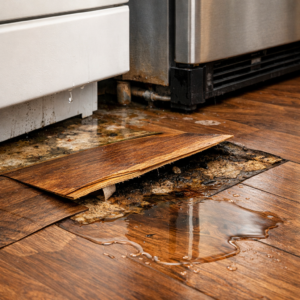
Why Early Leaks Stay Invisible
Small appliance leaks rarely create immediate puddles. In some cases, water under a washing machine means damage beyond the appliance and into surrounding materials like flooring. Water may drip slowly, spread outward, or be absorbed by surrounding materials. When this happens beneath a washing machine, dishwasher, or refrigerator, the surface often stays dry.
Flooring materials can hide moisture effectively at first. Some layers absorb water while others trap it underneath. Pausing to consider where water might travel, rather than where it appears, can help explain why leaks go unnoticed.
Hidden does not mean harmless.
How Moisture Moves Under Flooring
Once water reaches the floor, it tends to follow paths of least resistance. It can move along seams, under underlayment, or into gaps between materials. This movement is slow and uneven, which makes it hard to detect.
Different floor types react differently. Some swell slightly, others soften underneath, and some appear unchanged until damage is advanced. Slowing down assumptions about how water behaves can clarify why surface inspection alone is unreliable.
Moisture often spreads sideways before it shows upward.
Why Floors Can Look Fine While Damage Develops
Many floors are designed to look intact even when conditions underneath are changing. Protective finishes and surface layers can mask early deterioration.
Underneath, adhesives may weaken, materials may expand and contract, and structural layers may begin to lose integrity. Pausing to remember that appearance reflects only the top layer can prevent false reassurance.
Visual calm can hide structural change.
How Repeated Minor Leaks Add Up
A single small leak may dry without obvious impact. The problem arises when leaks repeat. Each exposure leaves behind residual moisture or stress, even if the surface dries. This gradual accumulation mirrors how washing machine leaks change behavior as internal damage spreads over time.
Over time, this repetition can change how the floor responds. Swelling may become permanent, or materials may stop returning to their original shape. Slowing down after repeated “minor” incidents can help recognize accumulation before it becomes visible damage.
Repetition matters more than intensity.
Why Damage Often Appears Suddenly
Floor damage from leaks often seems to appear overnight. A buckle, stain, or soft spot may show up with little warning. In reality, a threshold has been crossed. This reflects why appliance damage rarely stays at the same severity level before becoming visible.
Once materials lose enough strength or stability, visible failure happens quickly. Pausing to reframe “sudden” damage as delayed damage can make the timeline easier to understand.
The failure is sudden; the process is not.
How Floor Construction Influences Damage
Not all floors react the same way. Some constructions allow moisture to escape slowly, while others trap it. Layers beneath the visible surface play a major role in how damage develops.
When moisture is trapped, damage tends to be more severe and less reversible. Slowing down to consider what lies beneath the surface can explain why similar leaks cause very different outcomes.
What you can’t see often determines the result.
Why Cleaning Can Make Things Look Worse
When floor damage finally becomes visible, cleaning often makes it more noticeable. Moisture, heat, or pressure from cleaning can accentuate swelling, staining, or separation.
This can create the impression that cleaning caused the damage. Pausing before drawing that conclusion can help separate the moment damage became visible from when it actually formed.
Visibility does not equal cause.
When Stopping Is Safer Than Acting
If floor changes appear near an appliance, the instinct is often to clean, dry, or adjust immediately. In some cases, doing too much can spread moisture further or worsen distortion.
Stopping to reassess the situation can prevent accidental escalation. Doing less for a moment can preserve information about what is actually happening.
Hesitation can protect against compounding damage.
FAQ
Why didn’t the floor show damage earlier?
Early moisture often stays below the surface. Pausing to consider hidden layers explains the delay.
Can very small leaks really cause floor damage?
Yes, especially when repeated. Slowing down to notice patterns matters more than size.
Why does damage seem to appear all at once?
Because materials fail after gradual weakening. The process is slow; the outcome is fast.
Is visible floor damage always recent?
Not necessarily. Often it reflects older exposure. Doing less and reassessing can help clarify timing.