
Moisture problems from appliances are often associated with floors. Water is expected to spread outward along the ground, not upward. When wall damage appears, it can feel unexpected or unrelated. It is often worth slowing down at this point, because moisture from appliances can travel vertically long before obvious signs appear.
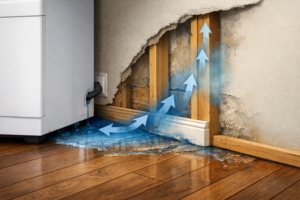
Understanding how moisture moves from appliances into nearby walls helps explain why damage sometimes shows up far from the original source. What looks like a wall issue may have started much lower and much earlier.
Why Wall Damage Feels Unrelated at First
Walls feel separate from appliances. They are vertical, distant from hoses and drains, and usually dry to the touch. When discoloration or softness appears, it is often blamed on humidity or external leaks.
This separation makes it easy to miss the connection. Pausing to consider what lies behind the wall surface can reveal pathways that are not visible. Moisture does not respect visual boundaries.
What feels unrelated may be connected beneath the surface.
How Moisture Moves Upward From the Floor
When water escapes from an appliance, it often spreads across the floor first. This is the same process described when appliance leaks damage floors before you notice, long before moisture begins affecting walls. From there, it can be absorbed into baseboards, drywall edges, or framing materials. These materials act like wicks, slowly drawing moisture upward.
This process is gradual and uneven. Walls may absorb moisture at different rates depending on materials and construction. Slowing down to understand this movement can explain why wall damage appears delayed.
Moisture often rises quietly before it announces itself.
Why Early Wall Signs Are Easy to Miss
Initial wall damage from moisture is subtle. Paint may bubble slightly, textures may change, or corners may feel different to the touch. These changes are easy to dismiss as cosmetic or seasonal.
Because they develop slowly, they rarely trigger immediate concern. Pausing to notice small, repeated changes can be more revealing than waiting for obvious damage.
Early signs are often ambiguous by nature.
How Repeated Exposure Changes Wall Materials
Just like floors, walls are affected more by repetition than by single events. A small amount of moisture absorbed repeatedly can weaken materials over time.
Drywall edges may soften, fasteners may lose grip, and framing may hold residual dampness. Slowing down after recurring moisture exposure can help recognize accumulation before it becomes structural.
Walls remember moisture longer than they show it.
Why Damage Often Appears Above the Actual Source
Wall damage is frequently noticed higher than where moisture entered. This can create confusion about the cause. In reality, moisture may have traveled upward inside the wall cavity before spreading outward.
By the time surface damage is visible, the original source may no longer be obvious. Pausing before assuming a new leak can help trace the issue back to its origin.
Visible damage is not always closest to the cause.
How Appliance Placement Influences Wall Impact
Appliances placed near walls create narrow spaces where moisture can linger. Limited airflow slows drying and encourages absorption into nearby surfaces.
Over time, these conditions make walls more vulnerable, even to small leaks. Slowing down to consider appliance placement can explain why certain walls are affected while others remain unchanged.
Proximity increases exposure, even without constant leaks.
Why Wall Damage Can Progress Faster Than Expected
Once wall materials begin absorbing moisture, deterioration can accelerate. Materials lose strength and resist drying, making each new exposure more impactful.
This acceleration can make damage seem sudden. This shift reflects why appliance damage rarely stays at the same severity level once moisture has weakened materials. Pausing to recognize that walls have already been weakened can help make sense of rapid changes.
Speed increases after thresholds are crossed.
When Cleaning or Painting Makes Things Worse
Attempts to clean or repaint affected walls can sometimes highlight damage rather than fix it. Moisture trapped beneath the surface may cause new bubbling, staining, or peeling.
This can lead to frustration or misinterpretation. Slowing down before covering symptoms can help avoid sealing moisture inside.
Fresh surfaces can hide active problems temporarily.
When Stopping to Reassess Is the Safer Choice
If wall changes appear near an appliance, immediate action can feel urgent. However, acting without understanding the moisture path can spread damage or obscure clues.
Stopping to reassess creates space to observe patterns and connections. Doing less for a moment can preserve information about how moisture is moving.
Restraint can prevent accidental escalation.
FAQ
How can appliance moisture affect walls?
Moisture can wick upward from floors into wall materials. Pausing to consider hidden pathways helps explain this spread.
Why does wall damage show up later than floor damage?
Walls absorb moisture gradually. Slowing down expectations can clarify the delay.
Can small leaks really affect walls?
Yes, especially when repeated. Repetition matters more than volume.
Is wall damage always caused by a wall leak?
Not necessarily. Appliances nearby can be the source. Doing less and reassessing can help identify connections.