
Appliance failures are often understood as mechanical or electrical events. A machine stops working, performs inconsistently, or shows visible signs of trouble. Moisture and mold are usually treated as separate concerns, linked more to building conditions than to appliances. It is often worth slowing down here, because appliance failures and moisture-related issues are frequently connected in subtle, indirect ways.
This article explores how appliance problems can contribute to moisture conditions that support mold growth, even when leaks or failures are not immediately obvious. Understanding this connection helps explain why mold issues sometimes appear without a clear or recent water event.
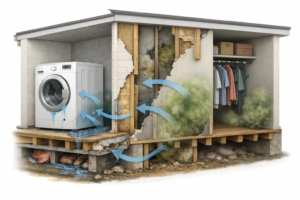
Why Appliance Failures Are Rarely Linked to Mold at First
When mold appears, attention usually turns to visible water sources, humidity, or ventilation. Appliances are often overlooked unless there is an obvious leak. This separation feels logical because appliance failures are seen as functional problems, while mold is seen as an environmental one.
The connection is easy to miss because it develops gradually. Pausing to consider how appliance behavior affects moisture levels can reveal links that are not immediately visible.
Different symptoms can share the same origin.
How Appliances Contribute to Moisture Without Leaking
Not all moisture comes from visible spills or drips. Appliances can introduce moisture through condensation, inefficient drainage, incomplete cycles, or altered temperature patterns.
When an appliance fails to regulate moisture as intended, surrounding materials may absorb small amounts repeatedly. This is similar to how appliance leaks damage floors before you notice any visible surface change. Slowing down to think beyond obvious leaks helps explain how moisture can accumulate quietly.
Moisture does not require a dramatic entry point.
Why Hidden Moisture Persists After Appliance Issues
Even when an appliance issue is corrected, moisture introduced earlier may remain trapped. Flooring, wall cavities, insulation, and cabinetry can hold moisture long after surfaces appear dry.
This persistence creates conditions where mold can develop later, seemingly disconnected from the original appliance problem. Pausing to separate the timing of moisture introduction from the timing of mold appearance can clarify confusion.
Dry surfaces do not guarantee dry conditions.
How Repetition Increases Mold Risk
A single moisture event may not lead to mold. The risk increases when exposure is repeated. Appliances that malfunction intermittently can introduce moisture in small amounts over long periods.
Each exposure raises baseline moisture levels slightly. This accumulation mirrors how repeated appliance moisture leads to hidden structural issues over time. Over time, this creates a stable environment for mold growth. Slowing down to consider frequency rather than severity helps explain why mold appears without a clear flood or leak.
Repetition matters more than intensity.
Why Mold Often Appears Away From the Appliance
Mold is often discovered in locations that seem far removed from any appliance. This can make the connection feel unlikely. In reality, moisture can travel through materials, air movement, or structural pathways. This spread follows the same pattern seen when moisture from appliances starts affecting nearby walls.
By the time mold becomes visible, the appliance-related moisture source may feel irrelevant or resolved. Pausing before dismissing older appliance issues can help reconnect cause and effect.
Distance weakens perception, not connection.
How Appliance Repairs Can Change Moisture Patterns
Fixing an appliance can alter how moisture moves, even if it does not remove all moisture. Changes in airflow, temperature, or drainage can redirect moisture into new areas.
This can lead to mold appearing after a repair, creating confusion. Slowing down to recognize that repairs change conditions—not just fix problems—can reduce misinterpretation.
Change does not always mean correction.
Why Mold Growth Feels Sudden
Mold growth often seems to appear overnight. In reality, conditions may have been favorable for some time before growth became visible.
Appliance-related moisture can quietly prepare materials for mold without immediate signs. Pausing to reframe “sudden” growth as delayed visibility can make the progression easier to understand.
The reveal is sudden; the setup is not.
How Appliance Location Influences Mold Development
Appliances placed in tight spaces, against walls, or within cabinets restrict airflow. When moisture is introduced in these areas, drying is slower and uneven.
These conditions make it easier for mold to establish itself. Slowing down to consider placement helps explain why some appliance failures lead to mold while others do not.
Location shapes outcome.
Why Mold Is Often Treated as a Separate Problem
Once mold is discovered, focus often shifts entirely to removal or remediation. The earlier appliance issue may be forgotten or dismissed as unrelated.
This separation can allow moisture conditions to persist. Pausing to consider whether the appliance contributed to the environment that allowed mold to grow can prevent repeating the cycle.
Treating symptoms without context limits understanding.
When Uncertainty Is a Warning Sign
Uncertainty about where moisture came from is common in mold situations. This uncertainty often signals a gradual, indirect source rather than a single event.
Appliance failures fit this pattern well. Slowing down to accept uncertainty as information—not failure—can help guide more careful assessment.
Unclear origins often mean slow processes.
When Doing Less Can Protect Clarity
In the presence of mold concerns, the urge to act quickly is strong. However, rapid changes—drying, sealing, or rearranging—can hide moisture pathways.
Pausing to observe patterns before intervening can preserve clues about how appliance failures and moisture are connected. Doing less initially can prevent losing critical information.
Restraint can support understanding.
FAQ
Can appliance failures really cause mold without a leak?
Yes. Condensation, incomplete drainage, or repeated minor moisture release can create conditions for mold. Slowing down to consider indirect moisture sources helps clarify this.
Why does mold show up after an appliance issue seems resolved?
Because moisture introduced earlier may remain trapped. The delay reflects accumulation, not a new cause.
Is mold always caused by one appliance?
Not necessarily. Appliances may contribute alongside ventilation or building factors. Pausing to view the situation as a system helps avoid oversimplification.
What’s the safest response when the connection is unclear?
Restraint and observation. Doing less while reassessing moisture patterns can prevent missing how the issue developed.